15 June 2026 · 6 min read
Indoor Golf for Game Improvement: Why More Golfers Are Training Indoors
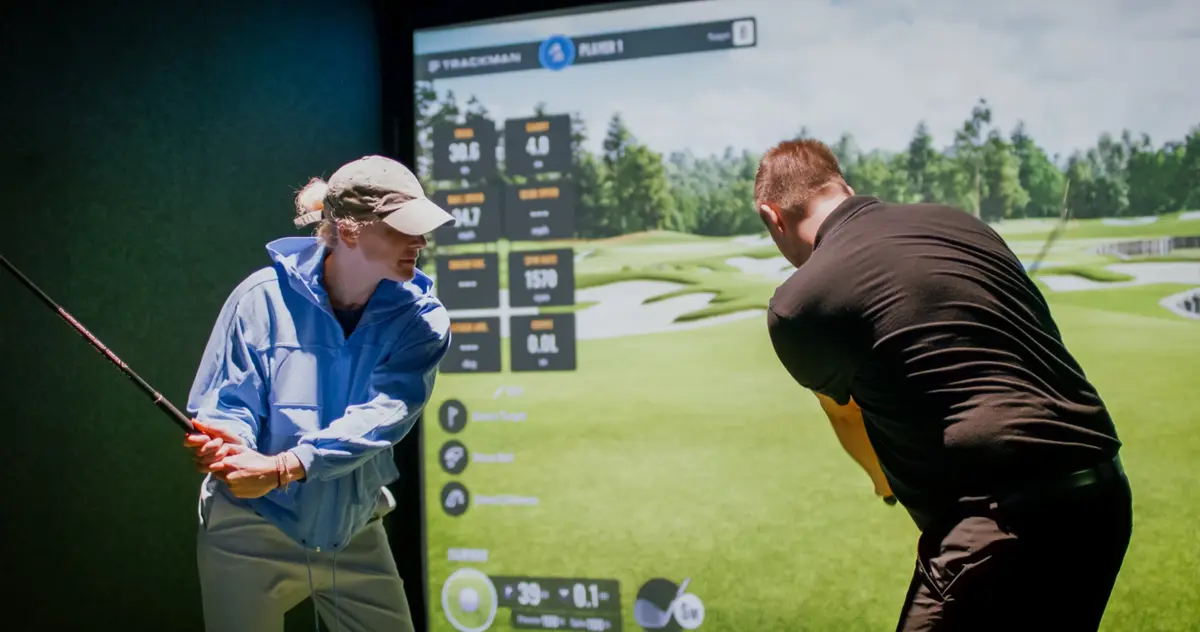
Outdoors the season is short, the range is crowded and your ball flight is guesswork. Indoors it is a different story: every shot is measured by TrackMan — ball speed, spin, launch angle, carry. Feel becomes knowledge, and knowledge becomes progress.
Why indoor practice works faster
On a driving range you hit a hundred balls and watch a hundred approximate ball flights. You know the strike felt good — but not whether those 165 metres came from too high a launch angle or too little spin. That is exactly the gap a simulator closes.
Indoors you get the same numbers after every shot, under the same conditions, with no wind and no waiting. Repeatability is the real advantage: you can make one swing change and immediately see whether it measurably helped, instead of guessing over weeks.
What TrackMan actually measures
TrackMan is the system used on the PGA Tour and by most teaching professionals. Among other things it captures:
Ball speed and club head speed — the basis of your distance. Smash factor, meaning how efficiently you transfer energy. Launch angle and spin rate, which together determine your flight curve. And carry rather than total distance, so you know where the ball actually lands.
These numbers are not an end in themselves. They tell you which of the four or five faults you are making simultaneously is costing you the most shots — and therefore what to work on first.
From feel to number, and back
The most common mistake in simulator practice is reacting to every single number. One shot tells you very little. The data only becomes useful as a pattern: ten shots with a 7-iron, and you can see whether your dispersion leans right, whether your launch angle wanders, whether your distance is consistent.
Give each session one theme. Not "get better", but something like "raise my driver launch angle" or "control pitching wedge carry at 100 metres". One theme, measured, tracked across several sessions — that is the difference between hitting balls and training.
Year-round golf, even through a Zurich winter
The Swiss golf season is short. For most golfers, November to March means a four- or five-month break — and in spring you start again roughly where you left off in autumn, often a little below it.
That is where the biggest gain sits. Spend an hour in a simulator every couple of weeks over winter and you do not start from zero in April. No weather, no daylight limits, no course closures. At INGOLF in Opfikon you book online and play at hours when nothing outdoors is possible — a few minutes from Zurich city centre or the airport on tram 10.
How to structure a session
An hour covers a surprising amount if it is structured. A format that works well:
Ten minutes hitting loosely, without looking at numbers. Twenty minutes on your chosen theme, with a deliberate pause between shots. Fifteen minutes of target practice — playing to a defined target rather than simply straight ahead. And the remainder on a real course, to test what you have learned under pressure.
At INGOLF you play over 500 courses worldwide. A round on a championship course is not just entertainment: it forces you to use every club once and live with the result, exactly like being outdoors.
Who benefits most
Beginners, because the barrier is lower than on a course and a coach is right beside you. Ambitious golfers, because the data exposes faults you can never cleanly isolate outdoors. And anyone who simply wants to play more than Swiss weather allows.
If you would like to try it: we are at Stelzenstrasse 6 in Opfikon, right next to Zurich. Book online, four TrackMan simulators, and a coach on request.